Modular vs hybrid vs custom vs bespoke stands: how to choose the right build for ROI
The first question most clients bring to our workshop is: “should we go modular or custom?” It sounds like a style choice. It isn’t. It’s a financial, logistical, and strategic decision that affects not just this event, but the next twelve months of your trade show programme.
We’ve built every type — pure modular Octanorm systems that fit in a van, Aluvision frameless walls that look custom but aren’t, BeMatrix frames with integrated LED, hybrid combinations that mix aluminium skeleton with bespoke finishing, and full one-off architectural builds. Each has a place. The trick is matching the right system to the right job.
Modular systems: the reuse workhorse
A modular exhibition stand is built from standardised aluminium components that lock together without welding, cutting, or permanent fastening. The dominant systems in the European market are Octanorm (German-engineered beam-and-profile system, industry standard since the 1970s), Aluvision (Belgian frameless SEG system, rising fast in the design-led segment), and BeMatrix (Belgian toolless frame system, strong in AV-integrated builds).
- Where modular wins. Speed of build — a 30 m² Octanorm stand goes up in 6–8 hours with two people. Reuse — the same profiles reconfigure into different layouts for different shows. Cost per event — after the initial investment, each subsequent build costs only graphics, transport, and labour. Weight and logistics — aluminium systems are lighter than wood builds, meaning lower transport cost and faster handling.
- Where modular has limits. Organic shapes, curved walls (unless you use specifically designed curved profiles), ultra-premium finishes that need seamless surfaces, and large-span open ceilings without visible structure.
- Typical cost. €280–€500 per m² for a complete modular build including graphics. Structure amortises across events — after 3–4 uses, the per-event structural cost approaches zero.
- Best for: Companies exhibiting 3+ times per year, brands that need consistent presence across multiple shows, exhibitors who value fast turnaround and low per-event cost.
Hybrid builds: the smart middle ground
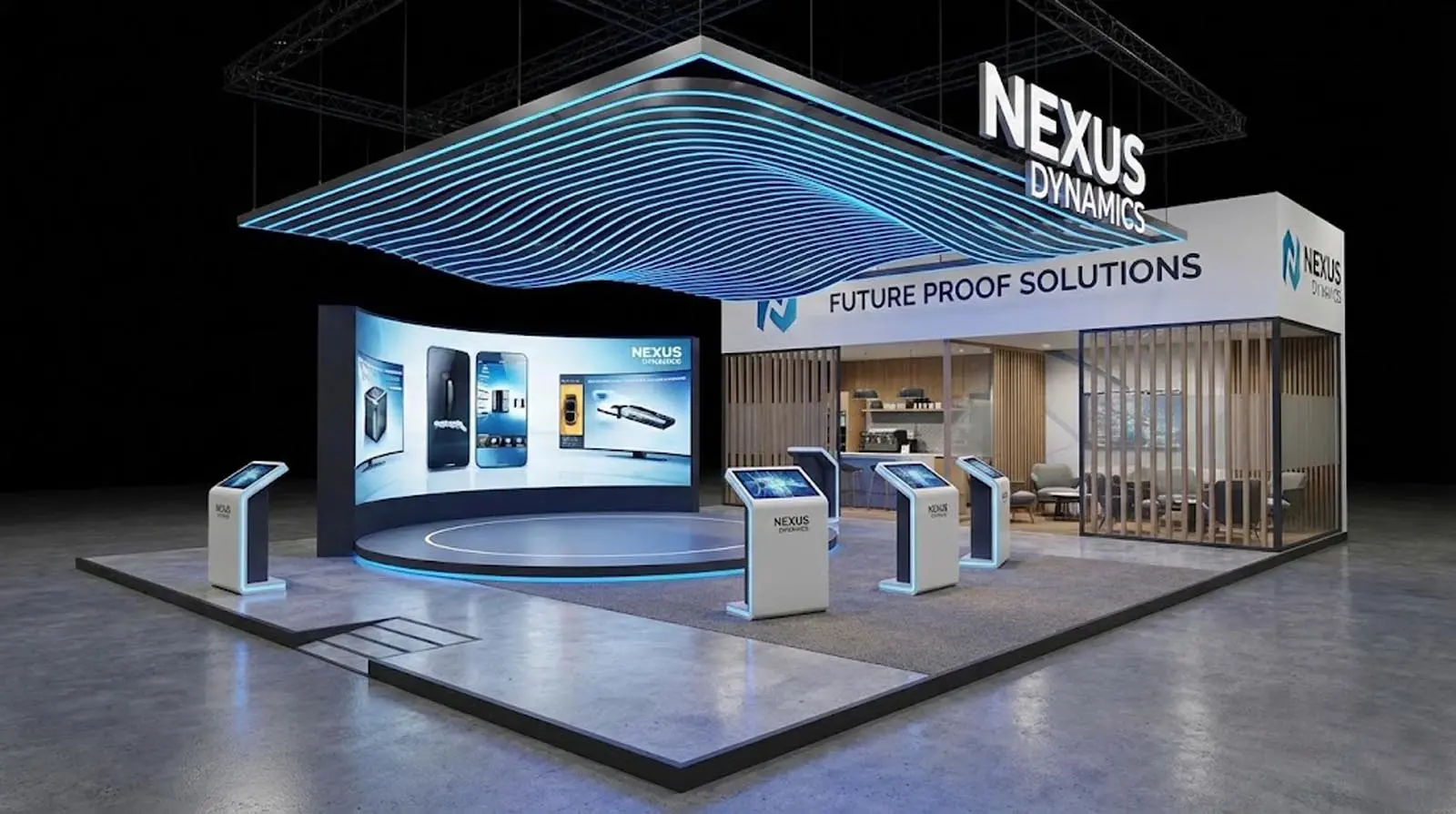
Hybrid is the fastest-growing category we build. The concept is simple: use a modular aluminium frame as the invisible skeleton, then add custom finishes that give the appearance of a fully bespoke stand.
In practice, a hybrid stand might use Aluvision SEG frames for the main walls (fast to build, reusable, lightweight), combined with a custom MDF reception counter (branded, specific to this client), raised flooring with flush cable channels (clean look, practical cabling), and integrated AV mounts designed specifically for this layout.
The modular elements come back to our warehouse after the show and get reused or reconfigured. The custom elements — counters, shelving, specific panels — may be single-use or adapted for the next event depending on design.
- Where hybrid wins. It looks custom to visitors but behaves like modular behind the scenes. You get the brand differentiation of a bespoke build with 50–70% of the reuse benefit of a pure modular system. Lead times are shorter than full custom because the structural frame comes from stock.
- Where hybrid has limits. The design must be planned around the modular grid. Aluvision frames come in standard sizes (typically 1,000 × 2,500 mm panels). Bespoke shapes need custom connecting hardware or separate structural solutions.
- Typical cost. €450–€750 per m². The modular portion amortises; the custom portion is event-specific.
- Best for: Mid-market brands at major shows (MWC, ISE, Alimentaria), companies that want differentiation but exhibit 2–4 times per year, products that need specific display or demo environments.
Full custom builds: the flagship statement
A full custom stand is designed and built from raw materials for a single event. No standardised profiles, no modular grid — just architectural design executed in wood, metal, composites, and whatever else the concept demands.
We use CNC routing for precision-cut MDF and plywood. Steel fabrication for structural frames, canopies, and hanging elements. High-pressure laminate, Corian, or solid surface for premium counters. Custom metalwork for product displays. Seamless painted surfaces with automotive-grade finish. Suspended ceilings with integrated lighting rigs.
- Where custom wins. Total design freedom. No structural grid to work around. Organic shapes, dramatic architectural volumes, seamless branding from floor to ceiling. For brands launching a product or entering a new market, a custom stand creates an environment that modular cannot replicate.
- Where custom has limits. Cost per event is high because there’s minimal reuse. Lead times are long — 14–20 weeks from concept to install. The build is heavier, requiring more transport volume and more install labour. Dismantling often involves destruction rather than disassembly, generating more waste.
- Typical cost. €700–€1,400 per m². Single-use in most cases, though some elements (counters, flooring) can be stored and reused with modification.
- Best for: Flagship launches, high-stakes brand moments, companies exhibiting once per year at a single major event, industries where premium perception drives deal value (luxury, automotive, pharma).
The decision framework we use with clients
We don’t ask “what style do you like?” first. We ask four questions:
- How many events per year? If three or more, modular or hybrid pays for itself. If one, custom or hybrid makes sense.
- Same layout or different? If every show uses the same plot size and configuration, pure modular is the most efficient. If layouts change by event, modular with reconfigurable elements (Aluvision is excellent here) or hybrid gives flexibility.
- What must happen on the stand? Live demos need reinforced surfaces, cable routing, and power planning that a modular system handles easily with the right accessories. Private meetings need acoustic consideration — hybrid builds with solid MDF meeting rooms offer better sound isolation than fabric-clad modular walls.
- What’s the brand’s visual bar? Some industries (pharma, finance, legal) value clean professionalism — modular delivers this beautifully. Others (fashion, luxury, automotive) need materials and finishes that only custom can provide.
A real cost comparison across three years
Take a company exhibiting at MWC and ISE each year — two events, 24 m² each.
Full custom route: €22,000 per event × 2 events × 3 years = €132,000.
Hybrid route: €16,000 first event (includes modular structure purchase), then €8,500 per event after (graphics, custom refresh, transport, install) × 5 remaining events = €58,500. Total: €16,000 + €42,500 = €58,500.
Pure modular route: €12,000 first event, then €5,500 per event × 5 = €27,500. Total: €39,500.
The modular route saves €92,500 over three years compared to custom. The hybrid saves €73,500. Even if modular “looks less premium” (debatable with current SEG fabric quality and backlit options), the savings fund dramatically better AV, lighting, content, and on-site staff.
What about “bespoke modular”?
This is the term we use for systems like Aluvision and BeMatrix that are technically modular (standardised frames, toolless assembly) but produce a visual result that looks fully bespoke. Frameless SEG graphics stretch edge-to-edge with no visible aluminium. Backlit panels glow uniformly. Curved configurations create organic shapes. LED integration (BeMatrix LEDskin) turns structural walls into video surfaces.
If someone told you in 2015 that a modular system could produce the visual impact of a €90,000 custom build at 40% of the cost, you’d be sceptical. In 2026, it’s our daily reality. The engineering has caught up with the ambition.
Frequently asked questions
Can a modular stand look as good as a custom build?
With current SEG fabric technology, backlit systems, and frameless profiles from Aluvision or BeMatrix — yes, for most applications. The exception is when you need organic sculptural shapes, seamless solid-surface finishes, or architectural elements that don’t follow a rectangular grid.
How long does a modular aluminium system last?
Octanorm profiles are rated for 200+ assembly cycles. We have stock that’s been in rotation for 8+ years with only minor connector replacements. Aluvision and BeMatrix frames have similar longevity. The limiting factor is usually hardware wear on locking mechanisms, not the aluminium itself.
Is hybrid more expensive than pure modular?
Yes — typically 30–50% more per event because of the custom finishing elements. But it’s 30–50% cheaper than full custom. For companies that need brand differentiation but exhibit multiple times per year, it’s the financial sweet spot.